Helping Teachers Use AI Effectively and Ethically
I help teachers develop the knowledge, skills, and judgment needed to use AI effectively and ethically in education. Through research, teaching, and professional development, I focus on practical strategies that help educators use AI to support learning while maintaining professional judgment and responsibility.
Generative AI-Supported Functions Across the Classroom Assessment Cycle
One framework I developed explores how generative AI can support teachers across the four phases of classroom assessment:
| Phase | How GenAI Can Help Teachers in Classroom Assessment |
| Develop assessments | -Draft assessments (e.g. items, performance tasks)-Align assessments to standards/rubrics |
| Collect responses | -Make assessment inclusive and accessible by adapting content, diversifying formats, and reducing bias.-Simulate student responses to test clarity and difficulty-Transcribe/Translate student input when needed |
| Interpret responses | -Process and organize student responses (e.g., summarizing, tagging, identifying incomplete data)-Assist with automated grading |
| Use assessment results | -Draft feedback summaries and insights-Draft post-assessment reports, and action plans-Recommend follow-up assessments or learning resources |
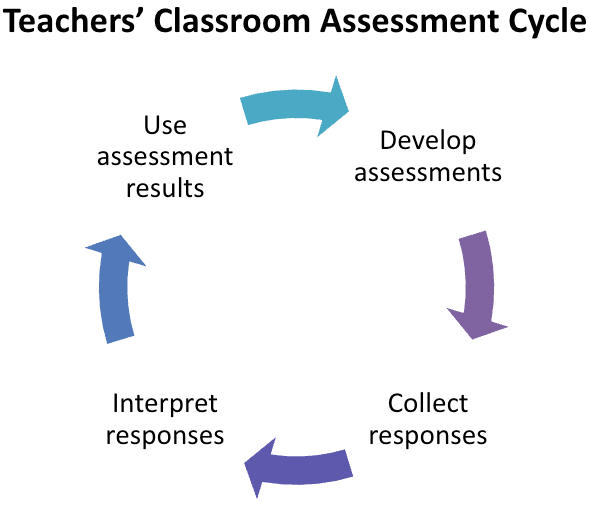
Across all four phases, AI serves as a support tool rather than a replacement for professional expertise.
Guiding Students to Use AI Wisely and Responsibly
In my workshops, I encourage teachers to move beyond simply detecting AI use and toward helping students use AI responsibly. One framework I use includes five key components:
1. Traffic Light Policy
Establish clear expectations for when AI use is encouraged, requires verification, or is not allowed.
2. Teaching Effective Strategies
Help students learn how to write prompts, evaluate outputs, and use AI as a learning tool rather than an answer generator.
3. AI-Resistant Assessment Design
Create assessment tasks that require personal reflection, real-world application, critical thinking, and authentic demonstrations of understanding.
4. Preventing Over-Reliance
Encourage students to develop their own ideas before turning to AI and emphasize learning over simply completing tasks.
5. Recognizing AI Use
Help students understand the limitations of AI and discuss how AI-generated content can be inaccurate, incomplete, or misleading.
Why This Matters
One of the most meaningful outcomes from my workshops has been seeing teachers shift from asking, “How do I stop students from using AI?” to asking, “How do I help students use AI responsibly?” I believe AI literacy is not simply about learning how to use AI tools. It is about developing the judgment needed to decide when, how, and why AI should be used. My goal is to help teachers become thoughtful, responsible, and effective users of emerging technologies.
 Ruiping Huang